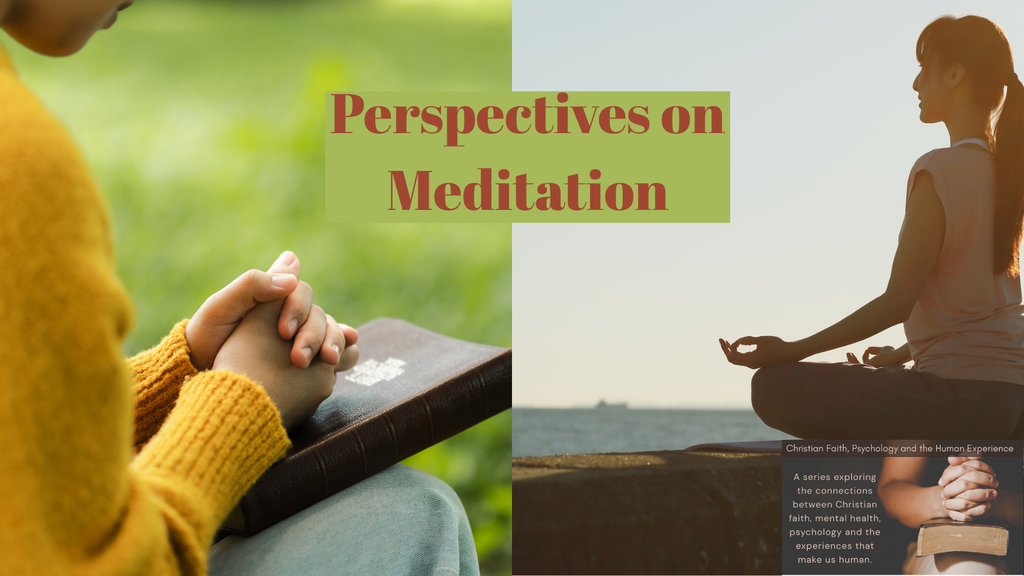
In this post exploring mental health and the Bible, I’m going to try to remain as factual as possible in regard to viewpoints on meditation that don’t match mine, while also pointing to the Biblical perspective on what meditation looks like from that worldview.
When working with clients, I like to use the person-centered principle of congruence, so I don’t offer anything that I wouldn’t do myself or that I feel might not be aligned to my worldview. If a client wants to try anything else, they have the autonomy to do so. In that sense, I am not limiting anyone to my worldview, but I’m not offering anything that I might deem harmful from a Biblical perspective.
I will divide this post into three descriptions of meditation:
- Secular / Psychological Meditation / Mindfulness
- Meditation in the New Age and Eastern religion traditions
- Meditation in the Bible
The NCCIH defines meditation as “a variety of practices that focus on mind and body integration and are used to calm the mind and enhance overall well-being. Some types of meditation involve maintaining mental focus on a particular sensation, such as breathing, a sound, a visual image, or a mantra, which is a repeated word or phrase. Other forms of meditation include the practice of mindfulness, which involves maintaining attention or awareness on the present moment without making judgements.”
Secular / psychological meditation / Mindfulness
When I speak about “secular” meditation I will be pointing to the non-religious perspective of the use of the word. It will focus on psychological tools and methods of meditation that relate very closely to what is in recent years called Mindfulness.
The benefits are named by people as supporting their general wellness, to prevent diseases, to relax or reduce stress, as well as improving sleep, help with pain management or with substance cessation.
The APA talks about the benefits of mindfulness being “related to its ability to dial down the body’s response to stress” by “influencing two different stress pathways in the brain, changing brain structures and activity in regions associated with attention and emotion regulation.”
It has been found that mindfulness can support people in managing and reacting differently to negative thoughts or unhelpful emotional reactions.
Some of the ways meditation appears in practice are: self-scanning or body centred meditation; contemplation; emotion-centred meditation; mantra meditation; meditation with movement; mindfulness meditation, visual-based meditation. (Find out more about each of these here).
The tools I use from the mindfulness practices are:
- Focusing on what your mind and body are doing and get to a place where we can start naming what’s coming up for the client and to interpret and understand that better, in order to get them to manage their emotions and bodily reactions in a more regulated and thoughtful way.
- Block breathing helps calm the nervous system and provide more oxygen to the brain and body, which in turn helps to lower cortisol, adrenaline and other activated systems, so the person can react in a calmer, more thoughtful way to their life situations.
Important aspects of mindfulness that combine with other therapeutic interventions can be:
- Staying in the here-and-now rather than in the past which might bring feelings of sadness and depression, or in the future which might bring anxiety.
- “Just notice” is something I use a lot, this means observing what’s going on in our mind and body without any judgement, just taking the information in results in changes in mindset and behaviour throughout time.
One last note is that meditation is a broad family of practices, which includes some of the ones mentioned above.
While many mention meditation in this sense as being beneficial, they recommend it alongside other forms of care – either medical, talking therapies or something similar.
From my Christian worldview, the part I become more cautious about is the idea of “emptying” or completely blanking the mind. Interestingly, this isn’t really what mindfulness requires anyway: psychologically, mindfulness involves paying attention to present experience rather than having no thoughts at all. I’ll return to why the distinction matters to me from a Biblical perspective later in this post.
Meditation in the New Age and Eastern Religion Traditions
Meditation can be traced back thousands of years, to the Eastern religions or traditions.
There are many ways of practicing New Age. It draws from Eastern religions alongside western esotericism, spiritualism, theosophy, new thought and other currents.
Meditation in this sense combines ideas about mystical self-knowledge, personal transformation, holistic mind-body-spirit development and other spiritual goals. (For more on this read this article).
There are different eastern traditions and religions such as Buddhism that aren’t New Age but the New age has borrowed from these.
Let’s focus on Transcendental meditation for this section. This relates to “an altered state of consciousness” as per Hindu writings and involves repeating a mantra, while sitting with your eyes closed for about 20 minutes. The mantra helps focus on that rather than on distracting thoughts and induce a state of relaxation. It is linked to mystic union in this article.
Before we move on to the next part, I’d like to just mention that from the outside it might look the same, but the same outward technique can acquire a different meaning according to the worldview surrounding it.
Meditation in the Bible
The Hebrew word הָגָה — hagah can be translated meditate, imagine, mourn, mutter, roar, speak, study, talk, utter, declare, ponder according to Strong’s Concordance.
So Biblical meditation isn’t necessarily an empty or even a silent activity. The word itself can carry the sense of pondering, speaking or muttering something over.
Joshua 1:8-9, as part of the sanctification process (as expressed by the commentary in Nelson, T. 2025), reads “This Book of the Law shall not depart from your mouth but you shall meditate in it day and night, that you may observe to do according to all that is written in it. For then you will make your way prosperous, and then you will have good success. Have I not commanded you? Be strong and of good courage; do not be afraid, nor be dismayed, for the Lord your God is with you wherever you go.” (in Nelson, T., 2025 Color Code Study Bible)
In terms of mental health, I can see how reflecting on God’s guidance, renewing our minds and trying to live accordingly might support our mental and emotional wellbeing and help keep us grounded in our faith.
Psalm 1: 1-3 equally mentions how someone can prosper – physically, mentally, emotionally – if they follow God’s guidance and commandments: “Blessed is the man who walks not in the counsel of the ungodly, nor stands in the path of sinners, nor sits in the seat of the scornful; but his delight is in the law of the Lord. And in His law he meditates day and night. He shall be like a tree planted by the rivers of water, that brings forth its fruit in its season, whose leaf also shall not wither; and whatever he does shall prosper.” (in Nelson, T. 2025 Color Coded Study Bible).
Again, meditating in this case relates to thinking, considering and living the word of God. Through following and reflecting on God’s works, deeds, ways, promises and character we can grow in health, wisdom, strength.
I want to include one final verse for this post (there are many more!):
“Finally, brothers and sisters, whatever is true, whatever is noble, whatever is right, whatever is pure, whatever is lovely, whatever is admirable—if anything is excellent or praiseworthy—think about such things.” – (NIV, Philippians 4:8, BibleHub)
As you can see, The Bible doesn’t tell us not to meditate. It tells us what to meditate on.
As always, I will end with a few questions to ponder or meditate on:
When I am meditating
- What am I attending to?
- Why am I doing it?
- What do I believe I’m connecting with?
- What do I believe is happening spiritually?
- Where do I believe truth (or Truth) comes from?
All the different ways of meditating described above might look remarkably similar to the onlooker.
The differences emerge when we ask the questions above.
Is the real difference between secular, New Age/Eastern and biblical meditation the act of meditation itself — or the object, purpose and worldview within which the person is meditating?